Don't Buy the Rog Keris Until You Read This Full Analysis
The landscape of performance gaming peripherals has shifted dramatically over the past several years. Where once weight and RGB lighting were the primary metrics of a "premium" mouse, modern enthusiasts now prioritize sensor accuracy, switch feel, cable flexibility, and, perhaps most importantly, long-term repairability. The ASUS ROG Keris enters this competitive arena not just as another lightweight gaming mouse, but as a specialized tool designed specifically for FPS players who value precision and technical longevity. However, in a market saturated with options from Logitech, Razer, and Zowie, the Keris occupies a unique niche that might not be suitable for every hand size or grip style.
Before investing in the ROG Keris, it is essential to understand that this is an asymmetrical mouse built with a very specific ergonomic philosophy. While many manufacturers attempt to create "safe" shapes that appeal to the broadest possible audience, ASUS has taken a more targeted approach. This analysis dives deep into the engineering, the ergonomics, and the everyday performance of the Keris to determine if its specialized features justify a spot on your desk, or if you should continue your search for the perfect click.
Detailed Product Analysis: Engineering for Precision
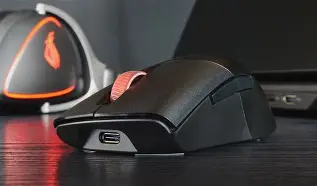
The ROG Keris is often described as a "compact" ergonomic mouse, but that description fails to capture the nuance of its structural design. At its core, the Keris is built around a honeycomb internal structure that provides rigidity without the external holes that some users find distracting or prone to dust accumulation. This results in a sturdy, creak-free shell that feels remarkably premium despite its light weight. One of the first things a user will notice is the PBT (polybutylene terephthalate) material used for the left and right mouse buttons. Unlike standard ABS plastic found on most mice, PBT is resistant to the "shine" caused by finger oils over time and provides a slightly textured, matte feel that improves grip during intense gaming sessions.
The Heart of the System: The ROG AimPoint Sensor
Performance in a gaming mouse is largely dictated by its sensor, and the Keris utilizes the ROG AimPoint optical sensor. In technical terms, this sensor offers a sensitivity range of up to 36,000 DPI, with a deviation of less than 1%. While most gamers will never actually use 36,000 DPI—typically hovering between 400 and 1600—the high ceiling is an indicator of the sensor's tracking accuracy and its ability to handle high-velocity movements without spinning out. During testing in fast-paced titles like Counter-Strike or Valorant, the tracking remains pixel-perfect, translating micro-adjustments into on-screen movement without any perceptible smoothing or acceleration.
The Push-Fit Switch Socket II
Perhaps the most compelling argument for the ROG Keris is the Push-Fit Switch Socket II. Electronic components, specifically mechanical switches, have a finite lifespan. The "double-clicking" issue has plagued many high-end gaming mice for years, often forcing users to buy a new device or learn how to solder. ASUS solves this by allowing users to literally pull out the existing mechanical switches and plug in new ones. The Keris comes with ROG Micro Switches rated for 70 million clicks, but the inclusion of the socket system means you can swap them for Omron, Kailh, or Huano switches to customize the actuation force and click sound. This feature alone extends the lifespan of the mouse significantly beyond its competitors.
Connectivity and Battery Engineering
The wireless version of the Keris features tri-mode connectivity: 2.4 GHz RF, Bluetooth, and wired USB. For competitive gaming, the 2.4 GHz "ROG SpeedNova" technology is the standard, offering sub-millisecond latency that is indistinguishable from a wired connection. The battery life is equally impressive, often reaching over 100 hours with the RGB lighting turned off. More importantly, the mouse supports fast charging, where a quick 15-minute top-up can provide several hours of gameplay. This reduces the primary anxiety associated with wireless peripherals: the fear of the device dying in the middle of a match.
Ergonomics and Hand Fit: A Specific Choice
The shape of the ROG Keris is clearly inspired by classic ergonomic designs but scaled down. It features a pronounced hump that sits further back than on the Razer DeathAdder, making it particularly well-suited for claw grip and fingertip grip users with medium-sized hands. Palm grip users with large hands, however, may find the mouse too short, leading to their fingers hanging off the front or their palm dragging on the mousepad.
Find top-rated Electronics products at great prices.
Shop Amazon →The side buttons are positioned high enough to avoid accidental clicks but remain easily accessible for the thumb. Interestingly, ASUS includes swappable side buttons in different colors (usually grey, pink, and silver) in the box. While purely aesthetic, it allows for a level of personalization rarely seen in the electronics category. The weight balance is centered, which is crucial for those who frequently "lift-off" their mouse to reposition it during low-DPI gaming.
Pros and Cons
- Internal Honeycomb Design: Provides a lightweight feel (approx. 75g for the wireless version) without the structural weakness or aesthetic drawbacks of external holes.
- PBT Polymer Buttons: Superior durability and texture compared to standard ABS plastic, preventing the common "greasy" look after months of use.
- Hot-Swappable Switches: The Push-Fit Switch Socket II is a game-changer for longevity and tactile customization, allowing users to fix double-clicking issues in seconds.
- Exceptional Sensor Performance: The AimPoint sensor provides industry-leading accuracy and high-speed tracking with minimal deviation.
- Paracord-like Cable: The ROG Paracord is extremely flexible and light, minimizing cable drag for those who prefer to play in wired mode or while charging.
- Comprehensive Accessory Pack: Includes extra switches, replacement mouse feet (Skates), and customizable side buttons, providing excellent value out of the box.
- Specific Shape: The compact, asymmetrical design is polarizing; large-handed users may find it uncomfortable for long sessions.
- Armoury Crate Software: The ASUS software suite can be resource-heavy and occasionally unintuitive compared to leaner alternatives.
- Limited Grip Styles: Primarily optimized for claw or fingertip grips; palm grip users may feel unsupported.
- Price Premium: The advanced features like hot-swappable sockets and PBT buttons come at a higher price point than entry-level gaming mice.
Comparison: ROG Keris vs. Industry Standards
To provide a clearer picture of where the Keris sits in the market, the following table compares its key technical specifications against other popular ergonomic gaming mice often considered by buyers in the same category.
| Feature | ROG Keris Wireless | Logitech G Pro X Superlight | Razer DeathAdder V3 Pro |
|---|---|---|---|
| Weight | 75g | 63g | 63g |
| Max DPI | 36,000 | 25,600 | 30,000 |
| Main Switch Type | Mechanical (Hot-Swappable) | Mechanical (Soldered) | Optical (Soldered) |
| Button Material | PBT Polymer | ABS Plastic | ABS Plastic |
| Connectivity | Tri-mode (2.4G, BT, Wired) | Dual-mode (2.4G, Wired) | Dual-mode (2.4G, Wired) |
| Charging Port | USB-C | Micro-USB / USB-C (v2) | USB-C |
Comprehensive Buying Guide: Is the Keris Right for You?
Buying a gaming mouse is a highly subjective decision, but there are several objective criteria you should evaluate before choosing the ROG Keris. Because this mouse is a significant investment, consider these three primary factors: Hand Size, Grip Type, and Value for Money.
Assessing Your Hand Size
The ROG Keris is generally classified as a small-to-medium mouse. If your hand measures more than 19cm from the base of your palm to the tip of your middle finger, you will likely find the Keris too small for a palm grip. However, for users with hands in the 16cm to 18cm range, the ergonomics are often described as "locked-in," providing a sense of control that larger mice cannot offer. Measuring your hand before purchase is the most effective way to avoid the ergonomics mismatch that leads to wrist fatigue.
Understanding Your Grip Style
The way you hold your mouse dictates how the weight and shape of the Keris will feel. Specifically:
- Claw Grip: The Keris excels here. The back hump supports the palm, while the PBT buttons provide a tactile surface for the fingertips.
- Fingertip Grip: The light weight and compact size make the Keris highly maneuverable for fingertip users, allowing for rapid vertical and horizontal movements with just the fingers.
- Palm Grip: Unless you have smaller hands, the Keris may feel "stumpy." The lack of length means your palm might not fully rest on the shell, leading to a hybrid grip that wasn't necessarily intended.
The Longevity Argument
If you are a consumer who hates the "e-waste" cycle of electronics, the Keris should be at the top of your list. Most mice are designed to be replaced when a switch fails. The Keris is designed to be repaired. When you consider the cost over three to five years, the Keris often becomes more affordable than "cheaper" mice because you can maintain its performance by simply swapping $5 switches rather than buying a new $100 device. This repair-friendly approach is a rarity in the modern electronics market and should be a major consideration for environmentally conscious or budget-savvy gamers.
Shop the latest Electronics picks on Amazon.
See Deals →Performance in Real-World Scenarios
While specifications on paper are impressive, the actual user experience in different genres of software is where the Keris proves its worth. In professional productivity environments, the Bluetooth mode allows the mouse to connect to laptops or tablets without needing a dongle, making it a viable "on-the-go" mouse for work. The silent operation of the scroll wheel is also a benefit in office settings.
In competitive gaming, the "click latency" is where the Keris truly shines. Because the mechanical switches are directly mounted into the Push-Fit sockets, there is very little pre-travel or post-travel in the buttons. This results in an instantaneous response time that is critical for "flick shots" in shooters. The mouse feet, made of 100% PTFE (Teflon), are rounded at the edges to prevent snagging on cloth pads, ensuring a smooth glide regardless of the surface texture.
Conclusion
The ROG Keris is not a mouse designed for the masses; it is a mouse designed for the enthusiast. It ignores the trend of "ultra-lightweight" (sub-50g) shells in favor of structural integrity and functional longevity. For the gamer who wants a reliable, high-performance tool that they can customize and repair themselves, it stands virtually alone in its category. The combination of the AimPoint sensor, PBT button shells, and the ingenious hot-swappable switch system creates a peripheral that feels like a long-term investment rather than a disposable accessory.
However, the compact and asymmetrical shape remains its most significant hurdle. Potential buyers must be honest about their hand size and grip style. If you are a palm-grip user with large hands, the Keris will likely cause frustration despite its technical excellence. But for the medium-handed claw or fingertip player who demands precision and durability, the ROG Keris represents one of the most well-engineered options currently available on the market. It is a specialized instrument that, when paired with the right user, delivers a tier of performance that justificies its place on any high-end gaming setup.